
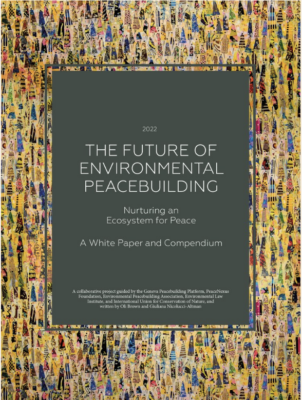
The Compendium of Voices on the Future of Environmental Peacebuilding
The Compendium of voices on the Future of Environmental Peacebuilding is a collection of 50 articles by authors from all around the world that accompanies the White Paper on the Future of Environmental Peacebuilding. Each article offers different visions and lessons learned for an ecosystem of peace, grouped across nine key themes: Foundations, Nature, Justice, Inclusion, Movement, Military, Governance, Innovation, and Cooperation. Learn more and explore the themes and accompanying art on the project website.
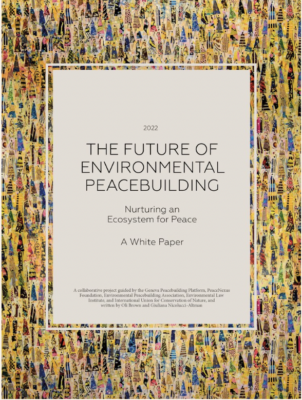
White Paper on the Future of Environmental Peacebuilding
The White Paper is a policy-oriented document developed through a collective process, steered by the Geneva Peacebuilding Platform, the International Union for Conservation of Nature (IUCN) and the Environmental Peacebuilding Association (EnPax), to advance a forward-looking, practical agenda for environmental peacebuilding. Presented at Stockholm+50 in June 2022, the White Paper was developed through a reflective, consultative, multi-stakeholder process to stimulate thinking, policy and funding for innovative programs and solutions around environmental peacebuilding. Learn more about the project and read the White Paper in Spanish, French, Chinese and Arabic.
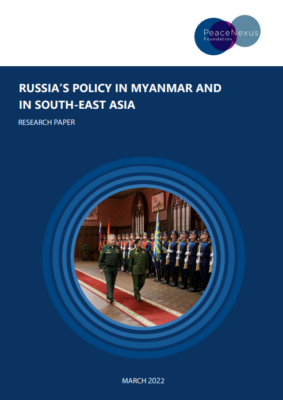
Report release – Russian Policy in Myanmar and Southeast Asia
On 1st February 2021, the Myanmar military regime attempted a coup d’état in Myanmar. In response, the international community condemned the regime’s attempt to seize power, leaving it with few friends. Among the friends is Russia, which has emerged as one of the Myanmar military regime’s key allies with an increasingly noticeable role in Southeast Asia. This research paper, prepared by Dr Anna Matveeva on behalf of the PeaceNexus Foundation, looks into the little-explored subject of Russia’s policy in Myanmar and the wider region. The paper is based on original research into primary and secondary sources and a number of key expert interviews conducted in Russia in December 2021 and January 2022*. Read the summary here and Burmese executive summary here.
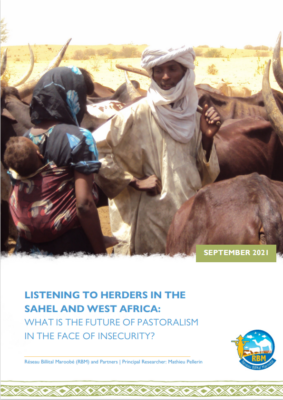
RBM’s Report release – Listening to herders in the Sahel and West Africa: What is the future of pastoralism in the face of insecurity
This report, published by our partner the Bilital Maroobé Network (RBM) stresses the impact of the security crisis on the pastoralist crisis in the Sahel and West Africa. Based on 1,898 testimonies of pastoralists and other key actors from 7 countries and 23 administrative regions most affected by insecurity, the study offers a unique insight into the root causes of these crises.
To access the synthesis report, click here.
To access the full report, click here.
Based on this thorough research, 3 policy briefs were produced showcasing key take-aways to improve the situation, that you can access here:
- Policy Brief n°1: Mobilizing Against Communitarisation: A Contributing Factor to Pastoral and Security Crises in the Sahel
- Policy Brief n°2: Rural and Pastoral Crisis, Security Crises: The Urgent Need to Break the Vicious Circle of Violence
- Policy Brief n°3: Restoring Hope and Dignity to Young Pastoralists by Giving them a Central Role in the Resolution of Current Crises
Confict Sensitivity Hub Report – Supporting CS through country-focused facilities: Lessons from Libya, South Sudan, Yemen and Lebanon
The international community has long recognised that aid can fuel conflict and has made important policy commitments to conflict-sensitive aid delivery. Yet operationalising these commitments remains challenging. Mechanisms such as helpdesks, framework agreements and internal efforts to support conflict sensitivity (CS) operationalisation have often been short-term, one-off or focused at the project and programme level without dealing with institutional blockages and challenges in the aid system itself. In recent years, a number of country-focused CS facilities have been created as an innovative way to deepen and broaden country-focused CS support. This paper summarises the findings of a review, led by the global Conflict Sensitivity Community Hub (CSC Hub), of three of the first country-focused and donor-funded facilities to explore lessons emerging from their work.